

Interview: Paula Chamlee: An Artist of Complexity and "Natural Connection"
NY MoMA Hires Makeda Best as Its New Chief Photo Curator
Nearly 100 New Photographs Recently Added to the I Photo Central Website, Which Now Has Over 4,500 Photographs for Sale
Iconoclast, Provocateur and Innovator Duane Michals (1932-2026) Passes away
Photo Collector and Historian Jack Wilgus Passes away after a Fall
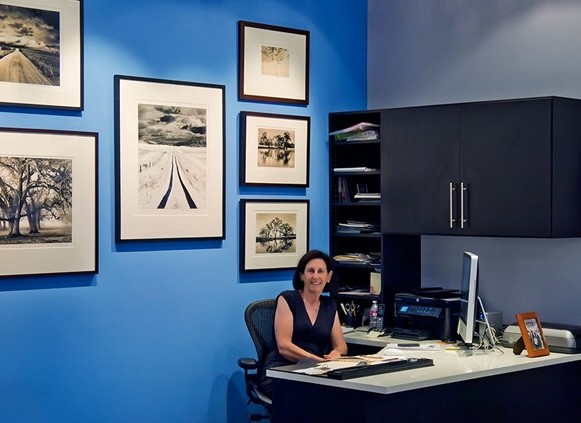
Susan Spiritus in her office.
Susan Spiritus is celebrating her photography gallery's 50th anniversary this month (actually on June 18th), making her public photo gallery one of the oldest of its type currently still in continuous business, let alone one that was founded by a remarkable woman. She has worked with some of the most influential photographers of their time, including George Tice, André Kertész, Ansel Adams, Lewis Baltz, Robert Doisneau, Yousuf Karsh, Eikoh Hosoe, Ruth Bernhard, Manuel Álvarez Bravo, Paul Caponigro, John Divola, John Gossage, JoAnn Callis, Robert Cumming, Imogen Cunningham, Robert Adams, Tony Hernandez, Joan Meyers and John Sexton, among others.
Susan has been one of my own dear friends and colleagues now for well over 25 years. Time passes by quickly though. As she recently told me: "I distinctly remember the thrill of throwing a dinner party for the gallery's 30th anniversary. I invited 100 guests—clients, collectors, artists and friends. It was hosted at the local museum, the Newport Harbor Art Museum. I remember getting up to welcome everyone and thanking them for being there—and telling them why they were invited because they were such an integral part of SSG's success, and it was my way to say thank you. Today, 20 years later, I am now pinching myself, asking how can this be?? It's been 50 years since SSG has opened! My family was young and now my daughters are grown women. I was 32 when I started and married only 10 years…. Today I am 82 and married 60 years! How can this be?"
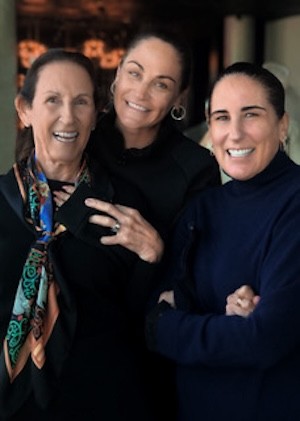
Susan and her two daughters, Lisa and Margo. (Photo by Barbara Runge)
Interestingly enough, Spiritus hadn't always been interested in photography. She earned her Bachelor's degree from the University of Buffalo in 1966, where she majored in Speech Pathology and Audiology, followed by a Master's degree in Special Education from Boston University in 1967, with an emphasis in Deaf Education. While living in Boston, she worked part-time at the Horace Mann School for the Deaf.
In 1968, Spiritus moved with her husband Gene to the island of Guam during his Navy service. Shortly after arriving, she learned that Guam had experienced a rubella epidemic in 1965, and as a result there were 60 deaf three-year-olds in urgent need of a teacher. The Government of Guam hired her, and for the two years she lived on the island (1968–1970), Susan worked closely with these children. Before her departure, all of them successfully matriculated into hearing kindergarten programs at local schools.
Upon returning to the mainland in 1970, the couple settled in California, where Susan and Gene began raising a family. At the same time, the couple developed an interest in collecting art, becoming friends with Jack Glenn of the Jack Glenn Gallery in Newport Beach. They collected modestly, and began frequenting the local museum, the Newport Harbor Art Museum (NHAM).
You weren't always involved with photography. Can you tell us how you were first drawn to it, and how you eventually got involved in the photo gallery business? How did you pick your first gallery location?
Prior to working with Jack Glenn in 1974, I had never been involved in the art world, although my parents had introduced me to New York City's vibrant theater scene at an early age. It wasn't until I met Gene in Buffalo—we were set up on a blind date in 1965, and after that first date I knew I was going to marry him!—that my interest in the arts truly began to develop. Gene spent countless hours studying and enjoying the collections at the Albright-Knox Art Gallery, and his enthusiasm gradually became my own.
In 1974, I contracted Meniere's Disease, a viral condition that affected my inner ear and ultimately left me deaf in my left ear, a condition now commonly referred to as single-sided deafness. The illness confined me to bed for an extended period and proved to be a life-changing event in more ways than one. During my recovery, Gene presented me with a get-well gift of four works of art that would unknowingly launch our collecting journey. He purchased photographs by Bill Brandt, Imogen Cunningham, and Harry Callahan, along with an etching by David Hockney. That thoughtful gift sparked what would become a lifelong passion for collecting and, ultimately, a career devoted to fine art photography.
When my health improved and I was able to venture out again, I spent much of my time at Jack Glenn's gallery. Jack eventually invited me to work with him, marking the beginning of a new chapter in my life.
It was during the short period working at the Jack Glenn Gallery that I organized two photography exhibitions, Photography I (March- April 1974) and Photography II (June -July 1975), where I met Lewis Baltz, John Divola, John Gossage, JoAnn Callis, Robert Cumming, Jacqueline Thurston, Robert Adams, Tony Hernandez and a few others.
But Jack Glenn wasn't the best business person, and he closed the gallery after just a couple of years. When I asked him, 'What was I going to do now?', he encouraged me to open up my own space.
Before opening my own gallery—and before we had even secured a location—Gene and I flew to New York to visit the photography galleries that were already established there. Among them were The Witkin Gallery, Castelli Graphics, and LIGHT Gallery. At The Witkin Gallery, an exhibition of George Tice's photographs was on view, and I responded to his work immediately.
Thanks to Lee Witkin, who graciously introduced me to George, I was able to visit his studio and become acquainted with both the artist and his work. I then arranged for George Tice to be the opening exhibition at my gallery on June 18, 1976.
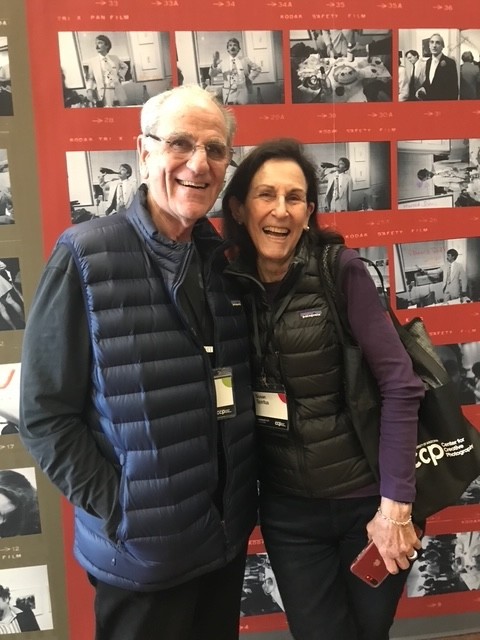
Gene and Susan Spiritus at the Center for Creative Photography's program Legacy of Light in 2020. Susan's husband Gene has been her biggest cheerleader and supporter.
I must admit that at the time I knew very little about how to operate an art gallery, but Gene was unwavering in his confidence, insisting that "you'll learn." What I did not know was that galleries typically received artwork on consignment and paid artists only after the work had sold.
During our visit to George's studio, I selected the photographs I wanted for the opening exhibition and promptly wrote him a check for the entire group, paying for them in full. George was stunned. With the check in his hand, he explained how the gallery business normally worked and then generously agreed to provide additional photographs on consignment.
That moment marked the beginning of a professional relationship and friendship that would endure for many years. Looking back, my ignorance of standard gallery practices may have been one of my greatest assets. Not knowing what I was supposed to do, I simply followed my instincts—and, in this case, they worked out quite well.
We then visited LIGHT Gallery to study how the space was organized and presented. As we walked through the gallery, we quickly realized that opening a photography gallery did not require elaborate furnishings or expensive fixtures. To get started, all we really needed were Solander boxes for print storage, track lighting, and clean white walls on which to display the work.
Returning home, we began searching for a suitable location and eventually found a small space in an affluent area of Newport Beach on Via Lido. The rent was just $600 per month—an amount that seems almost unimaginable today.
As plans for the gallery moved forward, I quickly became acquainted with John Upton at Orange Coast College, whose guidance and support proved invaluable. Through John, I was introduced to a talented young man in the photography department named George Wenslas. At the time, neither of us could have known that George would eventually come to work for me and become an important part of the gallery's early years.
What was your first show?
My first exhibition featured the work of George Tice. I framed the entire show, and it sold out. George was delighted to hear the news and promptly sent additional photographs on consignment, along with replacements for the pieces that had sold.
In the 1970s there were few women in the photography business: did you have any role models? Did you encounter any issues specific to being a woman in this business back then or now?
I have to say it has always been my husband's optimism that carried me forward and kept me going. I never encountered any issues specific to my being a women in the business—as there were only a few other photo dealers—Stephen White and G. Ray Hawkins—who were in the business in Southern California. Of course there was also Maggie Weston in Carmel.
You've worked with some of the biggest names in the business. How did you first convince them to work with you?
I never had difficulty convincing artists to work with me, as I was offering them both exposure and the opportunity for additional income if their work sold. My policy has always been simple: when a work sold, the artist was paid first, and always. I was once told I had a strong reputation as "the person who always paid—and always on time." Additionally, I have always been a "people person" and love the one-on-one type of relationship.
In the early years of the gallery, I took great pride in building personal relationships with the artists whose work I represented. I made it a point to visit them in their homes and studios, not only to better understand their work, but to get to know them as individuals.
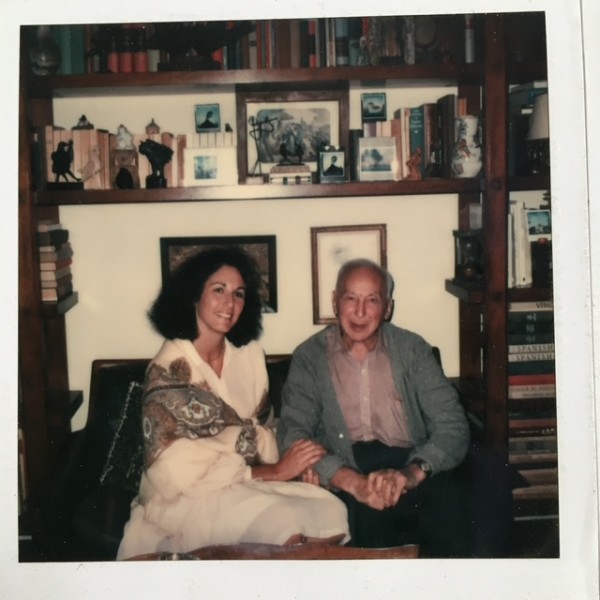
Susan with André Kertész in his New York apartment from a Polaroid taken by Susan Harder.
These visits led to many memorable experiences. One took me to Japan to meet Eikoh Hosoe, where we purchased one hundred gelatin silver photographs in preparation for his 20-year retrospective at Susan Spiritus Gallery. Another brought me to Santa Fe, New Mexico, to visit Laura Gilpin in her studio. During our conversation, she generously offered to trade her photographs for mine—assuming I was a photographer. I had to confess that I was, in fact, a gallerist hoping to purchase her work, much to both our amusement and disappointment.
Other highlights included hosting Yousuf Karsh for a book signing and exhibition at the gallery, and traveling to New York to meet Andre Kertész in his Fifth Avenue apartment. That visit was arranged through his gallerist, Susan Harder, with whom I have maintained a valued friendship throughout all these years.
Who were some of your favorite artists that you've worked with, and why?
Favorites...that is always a difficult question to answer, because a "favorite" can shift depending on what you are living with at the moment. As new artists and new bodies of work are added, new favorites inevitably emerge.
If I had to name a few, I would include Robert Doisneau, André Kertész, George Tice, Jerry N. Uelsmann, Paul Caponigro and Eikoh Hosoe.
Early in my career, I had the pleasure of meeting Imogen Cunningham and spending a day with her at SFMOMA for the exhibition Women in Photography. It was a wonderful day spent viewing the show, during which she offered many candid observations about the photographers' work. We began the tour just the two of us, but as we moved through the museum, others joined us along the way, eager to listen. By the end, there were nearly 50 people accompanying us. We ended the day back at her studio where I was able to purchase as many prints as I chose. Of course, I did and still have many in my private collection.
What did you do to build your business and develop a customer base at the beginning?
The answer is quite simple: I relied on our circle of friends and Gene's business relationships—primarily physicians.
It is also worth noting that for many years—decades, in fact—I never drew a salary from the gallery. All funds collected were consistently reinvested into the business, covering operational expenses and my employee's salary.
When the business began in 1976, there were no cell phones or computers. I relied on my Smith Corona typewriter, preparing a monthly newsletter from the kitchen-turned-office in the house we rented as the first gallery space. Each newsletter was mailed to our readers by hand—we purchased postage, folded and stuffed envelopes, and affixed every stamp ourselves.
How are you promoting the gallery now?
Today, I still produce bi-monthly newsletters, though they are now distributed electronically, and the gallery maintains a strong presence across social media platforms.
Over the years, I have placed photographs in major hospitals, large corporations, hotels, restaurants, as well as medical offices, law firms, and libraries. To my surprise at the time, I also worked with a major cruise line, placing artwork aboard their ships.
I know that you traveled with your husband Gene. Tell us about those travels and how they involved the gallery and your photography business.
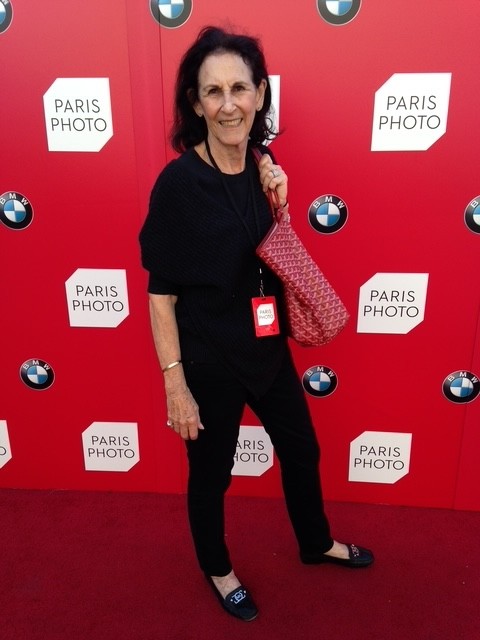
Susan attending Paris Photo.
In the early days of SSG, when few knew who Susan Spiritus was, I made it a point to travel widely to meet artists and collectors across the country. Long before art fairs became common, I would accompany my husband to his medical conferences and use those trips as an opportunity to conduct business, often setting up the gallery in our hotel room and selling works directly from there. Those travels helped me build a new collector base and led to many memorable—and often very amusing—encounters with hotel staff trying to understand my "business" being conducted from a guest room.
Gene and I have traveled extensively and even internationally, both for business and personal pleasure. One of our earliest business trips was to Tokyo to meet with Eikoh Hosoe, where we selected 100 works for his 20-year retrospective, 1960–1980. That exhibition became the inaugural show for my new gallery space in Newport Beach—a building Gene and I designed and built in 1979. It was a remarkable space: a 3,000-square-foot glass block structure designed by the locally and internationally renowned architect Brion Jeannette.
We also traveled to France many times for both business and pleasure, meeting with Jean-Claude Lemagny of the Bibliothèque Nationale, as well as French artists Jean-Claude Sudre, Robert Doisneau of RAPHO and Philippe Salaun, among others.
When you compare today with when you started, what are the challenges that you see for the photography business? What are some of the major changes, and how have you had to adapt?
Fifty years is a long time in which to make comparisons in any business. What has changed? Everything—and, I might add, for the better.
One of the greatest challenges over those 50 years was not having a local photography community to draw from or work with. Newport Beach is located about 50 miles south of Los Angeles, and the two communities are quite different. Traffic has always been a significant issue in either direction, and most people simply did not want to make the trip. Without a nearby gallery network to collaborate with—no photo walks, no shared openings—I often had to work entirely on my own.
In some ways, that was a disadvantage, but it also had its benefits. It forced me to make all of the decisions for SSG independently and develop a clear sense of direction from the start. Over the years, I moved the gallery more than most, but only when I felt a better location presented itself. It was never really an issue; people always found us. We were, after all, the only fine art photography gallery between Los Angeles and San Diego.
With the onset of the COVID years the gallery changed significantly. I moved out of my then current location, but didn't want to move it 'home', so I found a small office display space where I could keep my inventory and still meet with clients, one on one, by appointment only. My husband, the physician, told me to wear a mask and keep my distance if I were to be meeting with anyone. Things had now to change once again. There would not be any more exhibitions. I also started working from my home computer and I liked it. I have maintained this working situation and it's just fine.
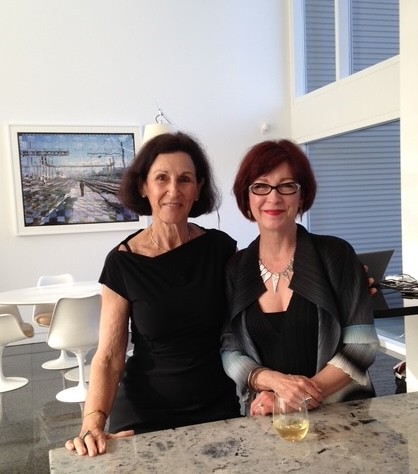
Susan visiting her artist Cara Barer’s studio.
I maintain the gallery's website and my daughter Lisa has done all of the gallery's social media for the past number of years. When she started working with me I had 200 followers on Instagram and now the gallery's account has almost 7000.
Living artists whom I continue to work with include Jane Fulton Alt, Camille Seaman (Denmark), Cara Barer, Ellie Davies (UK), Helga Stentzel (UK), Ellen Jantzen, David Burdeny (Canada), Hengki Koentjoro (Indonesia), Harold Ross, Leslie Gleim, Xan Padron, Tim Hyde, Robert Buelteman, Hakan Strand (Sweden), Christopher Burkett, Jeffrey Becom, Seung Hoon Park (Seoul) and numerous others. I have an in-depth inventory of early work from the 1970's and offer that work for sale as well.
You can view Susan Spiritus Gallery’s website at: https://susanspiritusgallery.com.
Novak has over 49 years experience in the photography-collecting arena. He is a long-time member and formerly board member of the Daguerreian Society, and, when it was still functioning, he was a member of the American Photographic Historical Society (APHS). He organized the 2016 19th-century Photography Show and Conference for the Daguerreian Society in NYC. He is also a long-time member of the Association of International Photography Art Dealers, or AIPAD. Novak has been a member of the board of the nonprofit Photo Review, which publishes both the Photo Review and the Photograph Collector, and is currently on the Photo Review's advisory board. He was a founding member of the Getty Museum Photography Council. He is author of French 19th-Century Master Photographers: Life into Art.
Novak has published numerous photography articles and columns in several newspapers, including the Photograph Collector, Focus magazine and the Daguerreian Society Newsletter. He has been interviewed extensively on the photography art market by the Financial Times, the New York Times, the Boston Globe, the Philadelphia Inquirer, The Classic magazine, Maine Antique Digest, the Art Newspaper, Art News, Art Business News, Focus magazine, PDN, Black & White magazine, Photographie Internationale, Antiques & the Arts Online, Art Critical and the Photograph Collector newsletter, as well as by many other publications, television programs and websites, both in the USA and in France. He was quoted extensively in the book, "Collectingphotography" by Gerry Badger. He has spoken at numerous photography events and programs.
He writes and publishes the E-Photo Newsletter, the largest circulation newsletter in the field. Novak is also president and owner of Contemporary Works/Vintage Works, a private photography dealer, which sells by appointment and has sold at exhibit shows, such as AIPAD New York and Miami, Art Chicago, Classic Photography LA, Photo LA, Paris Photo, The 19th-century Photography Show, Art Miami, the Daguerreian Society, etc.
Interview: Paula Chamlee: An Artist of Complexity and "Natural Connection"
NY MoMA Hires Makeda Best as Its New Chief Photo Curator
Nearly 100 New Photographs Recently Added to the I Photo Central Website, Which Now Has Over 4,500 Photographs for Sale
Iconoclast, Provocateur and Innovator Duane Michals (1932-2026) Passes away
Photo Collector and Historian Jack Wilgus Passes away after a Fall


Share This